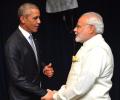
Prime Minister Narendra Modi and President Barack Obama on Monday decided to "further refine" the Indo-US strategic partnership while pushing ahead with cooperation in the areas of security, counter-terrorism, defence, economy and climate change.

We are back to the 1971 moment with both China and the US supporting Pakistan, asserts Colonel Anil A Athale (retd).

Modi, in an op-ed published in the Wall Street Journal, wrote that the US and India are forging a deeper and stronger partnership that extends far beyond the Beltway and the Raisina Hill.

India would confront a more entrenched China, a less dependable United States, and a regional order increasingly shaped by great-power bargaining over which it exercises limited influence, notes Amberish K Diwanji.
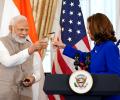
India and the US are working with renewed trust in areas of new and emerging technologies, Prime Minister Narendra Modi said on Friday as he thanked the American leadership for giving him a grand welcome.
The Congress party is set to challenge the Modi government on a range of critical issues, including alleged theft of Ram temple donations, 'systemic corrosion' of the education system, and constitutional amendment bills related to delimitation and dismissal of ministers, during the upcoming Monsoon Session of Parliament.

The Communist Party of India Marxist on Thursday vowed to oppose a strategic alliance between India and US, stating such a move is aimed at countering China. ''We shall not rest in our fight till the strategic ties with the US is snapped out,'' Karat said at a CPI(M)-sponsored programme in Kolkata to celebrate the October Revolution. He said the US was trying to make India its strategic ally in countering China, which is "the most powerful socialist country."

'The flip side of this is that he won't hesitate to call out India if he thinks its policies are hurting US economic interests or border US foreign policy goals.'
The second round of the Indo-United States strategic dialogue, co-chaired by External Affairs Minister S M Krishna and US Secretary of State Hillary Clinton, has been postponed in view of the Assembly elections in India and ongoing developments in West Asia and North Africa.
The fundamental challenge to United States-India strategic cooperation is China, says Daniel Markey, senior fellow for India, Pakistan, and South Asia at the Council on Foreign Relations, where he specialises in security and governance issues in the subcontinent.

The Congress on Sunday lashed out at Prime Minister Narendra Modi over the US' statements after three Indian sailors were killed in American attacks on ships, with party leader Rahul Gandhi saying the "compromised PM" listens "like an obedient servant" and "complies with the orders".
India and the United States will hold the second round of their strategic dialogue in New Delhi on April 6 during which US Secretary of State Hillary Clinton would lead the American side, Foreign Secretary Nirupama Rao has announced in Washington.
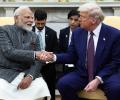
Prime Minister Narendra Modi on Saturday 'deeply' appreciated United States President Donald Trump's 'positive assessment' of the India-US partnership after the American leader hailed the 'special' relationship between the two nations -- remarks seen as an attempt to check the downturn in the ties.

The Congress party has criticized Prime Minister Narendra Modi's description of India and the US as 'natural partners,' citing President Trump's claims of using trade as leverage in India-Pakistan relations. The remarks come amid ongoing trade negotiations and fluctuating relations between the two countries.

The deal shifts the US posture towards India from hostile to neutral, and that matters for growth, points out T T Ram Mohan.
The Indian and American people, belonging to two vibrant democracies, are the "lifeblood" of the Indo-US strategic partnership, said India's Ambassador to the United States Nirupama Rao while addressing over 300 members of the Indian American community and its leaders, senior US State Department officials, state and local bureaucrats and lawmakers.

The Centre is regularly holding consultations with stakeholders to streamline foreign direct investments (FDIs) and foreign institutional investments (FIIs) related processes to enable faster and more efficient investment flows into the country, said Commerce and Industry Minister Piyush Goyal, adding one such meeting with stakeholders was held on Tuesday.

Prime Minister Narendra Modi and US Vice President JD Vance have expressed satisfaction with the progress made in negotiations for a bilateral trade agreement. The two leaders met in New Delhi and discussed a range of bilateral issues, including cooperation in energy, defense, strategic technologies, and other areas. They also exchanged views on regional and global issues of mutual interest.
Dismissing apprehensions that the Indo-US strategic relationship may harm the interests of India's neighbours, the United States has said contrary to this, the tie-up will be beneficial to the whole region.\n
United States Secretary of State Hillary Clinton will arrive in New Delhi on Monday to attend the second round of Indo-US strategic dialogue on Tuesday during which a host of key bilateral, regional and international issues including situation in Afghanistan and Pakistan and security cooperation in the backdrop of recent Mumbai blasts will be discussed.
The talks between S M Krishna and Hillary Clinton covered important bilateral issues like Afghanistan, nuclear waiver, defence purchases, terrorism, cyber security and US demands for market access, particularly in insurance and retail trading. Sheela Bhatt reports.

Speaking on 'India and the United States -- A Growing Partnership', she said the two leaders agreed to work together bilaterally and with all other countries to ensure a comprehensive and balanced outcome at the climate change meeting in Copenhagen.
Significantly, the official spokesman of the Russian foreign ministry said in a statement posted on the ministry's website that the new guidelines adopted by the NSG to ban the sale of ENR technology to NPT non-signatories would not apply to India. This unambiguous statement was made just a few days before the Indo-US Strategic Dialogue
"The best is yet to come" in the relations between India and the US, Mulford said.
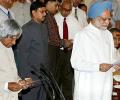
The landmark India-US civil nuclear deal of 2008, brokered during Manmohan Singh's tenure as Prime Minister, is seen as a crowning achievement in his foreign policy legacy. The agreement ended India's nuclear isolation, fostered a strategic partnership with the US, and opened doors to advanced technologies and defense cooperation. This historic deal also laid the groundwork for India's engagement with the global nuclear community.

'However, we must implement a tit-for-tat approach -- reciprocating their conduct with precision.' 'If they demonstrate respect, we respond accordingly. If they adopt hostile positions, we mirror that hostility with equal intensity.'

Prosperity was not possible without peace, the minister said.

Prime Minister Manmohan Singh and United States President Barack Obama will meet in Washington on Thursday to chart a course for "future cooperation" in areas such as civil nuclear technology, trade, investment, defence and counter-terrorism, amid perceptions that bilateral strategic ties have plateaued.

An interview with former US assistant secretary of commerce Raymond E Vickery speaks on his book The Eagle And The Elephant: Strategic Aspects Of Us-India Economic Engagement.

Gokhale has said that China used its "close connections" with the Left parties in India to "build domestic opposition" to the Indo-US nuclear deal.

Recognising the threat posed by outfits like the Al Qaeda, Lashkar-e-Tayiba and the Dawood Ibrahim network, India and the United States have agreed to deepen cooperation in fighting terrorism and asked Pakistan to bring to justice the 2008 Mumbai attack perpetrators.
"Our bilateral engagement with the United States has witnessed remarkable transformation and has matured into a strategic partnership of global dimensions," Rao said in her speech at the American University on 'India's role in a Changing World'
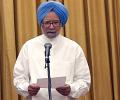
Former Indian Prime Minister Manmohan Singh's effusive praise of US President George W Bush during their 2008 meeting in the White House is revisited as a testament to their close relationship and the impact of the landmark Indo-US civil nuclear deal. Singh's statement, while drawing criticism from the Left and BJP, highlighted the transformative nature of the relationship between the two democracies. The article explores the context of their meeting and the broader significance of their relationship in the context of the Indo-US nuclear deal.

The Indian industry has thus joined hands with the government in urging Americans to lift stringent export controls on high-technology transfer.
United States firm Westinghouse Electric and the Nuclear Power Corporation of India Ltd on Wednesday signed a preliminary pact for an Early Works Agreement for installation of the first 1,000 MW American nuclear reactor in India under the historic 2008 Indo-US civil nuclear deal.

Flynn is believed to have expressed his 'high respect' for India's growth in modern times.
By signing the 123 Agreement, India is effectively giving up it 34-year-old nuclear deterrent at a time when China is enhancing its own nuclear capability. (So is Pakistan; both China and Pakistan are, unsurprisingly, delighted with the 123 Agreement). In return, we will be "allowed" to give Western and Russian civil nuclear infrastructure companies business (from Indian taxpayers' money) worth over $120 billion
'I do not see this turning into a strategic alliance because I doubt if India would let this partnership dilute its strategic relations with other nations including Russia and China.'
The ongoing ties with the US will help Indians gain political clout in Washington much like the Israeli Jews, Chairman of the Taskforce on Global Strategic Developments K Subrahmanyam said Thursday.
